The Motherchain Effect
Since day zero at Flashnet, we've built a lot... A Lightning DEX, a hilariously slow and expensive L1 exchange, the first working prototype for Spark, and of course, we eventually(!) gave life to Flashnet itself. Looking back, I keep asking myself - how did we pull this off until now? And what does that mean for what comes next?
I like to think about knowledge in a few distinct buckets: what you know that you know, what you know that you don't know, what you know when there's nothing to know, and finally - what you don't know that you don't know. That last category is the hardest to work with because it makes planning nearly impossible. As someone who wants to bring order to uncertainty, you try to make plans. But plans require knowledge. For the majority of my time at Flashnet, I was squarely in that last category - I didn't know what I didn't know. For the majority of my time at Flashnet, we were navigating with a compass that only worked sometimes and a map that was mostly blank.
I had never built on Bitcoin when I joined Flashnet. In fact, I'd left crypto entirely in 2021, convinced I was done for good. If I ever came back, I figured it would be for protocol work on Ethereum - but Bitcoin? I didn't even know building on Bitcoin was possible. I had no idea what existed in that ecosystem, how the market differed, how the community operated. I really didn't know Bitcoin. But I respected it deeply, because it was the motherchain. The chain "you cannot build on top of" - which was the core of my respect for it. Now, sitting in my house reflecting on the past two years, my respect and gratitude for Bitcoin have only grown. But the foundation of that respect has completely shifted - I once revered it for what you couldn't do with it. Now I revere it for what you can.
Why? Two things, because I won't talk about security like any other Medium post.
Reason one - markets. Coming from Ethereum, I thought I understood trading systems. I was completely wrong. On Ethereum, liquidity lives in smart contract pools - the abstraction does all the work. On Bitcoin, there is no abstraction. Every trade is a UTXO state transition you construct by hand. Market design is protocol design.
On Bitcoin, your market architecture is your security model. You can't bolt them together afterward. Every order, every match, every settlement has to be designed around UTXO constraints from day one. The constraints aren't limitations - they're the entire point.
Even AMMs on Bitcoin only became possible recently, as products of new protocols. Not because people weren't trying - Bitcoin's UTXO model fundamentally resists the pooled liquidity abstraction that makes AMMs trivial on account-based chains. For years, if you wanted AMM-style trading on Bitcoin, you were out of luck.
That's what I call cryptographic creativity - building new primitives while staying constrained by Bitcoin's rules. It's not about being clever for cleverness' sake. It's about spending weeks staring at UTXO models and signature schemes until you find a way to make them do something they weren't originally designed for, without breaking what makes them secure. Spark uses FROST because it's one of the few threshold signature schemes Bitcoin's cryptography actually supports. No bridges. No wrapped tokens. No "just move it to another chain." Every design decision is a negotiation with Bitcoin's constraints - and most ideas don't survive that negotiation.
The real challenge isn't "thinking creatively." It's accepting that 95% of what works on Ethereum won't work here. Your job is to rebuild from first principles until you find the 5% that does. You don't change Bitcoin to suit your ideas - you change your assumptions about what's possible.
And once you understand that, wilder things become possible. With Spark, theoretically, we will be able to achieve a central limit order book performance on Bitcoin with sub-second settlement latency. The kind of performance that was supposed to require sacrificing decentralization. For years, the narrative was "Bitcoin is slow, serious trading happens on CEXs or Solana." We just hadn't built the right market structure yet. With that said, I know better infrastructures are yet to come, which is only exciting.
Reason two - capital efficiency. On Ethereum, capital in AMM pools is relatively passive. You deposit liquidity, the pool handles trades, you collect fees. It works. On Bitcoin, capital has to move differently. Through Lightning channels. Across UTXO denominations. Between counterparties. Every satoshi needs to be positioned correctly, or routing fails.
Building Flashnet meant solving questions Ethereum's model doesn't surface as directly about fund management for both high concurrency and performance. How do you minimize the excess balance in-transit? How do you structure UTXOs so they're actually usable at scale? This comes down to a larger problem that is not even nearly solved yet - how do you make capital serve multiple purposes without creating bottlenecks?
And then there's distribution. On Ethereum, getting capital into pools is straightforward - deploy a contract, LPs deposit. On Bitcoin, capital distribution is a coordination problem. You're managing UTXOs, and if you want faster onboardings and withdrawals you support Lightning, meaning you need to manage channel capacity, liquidity routing across nodes. Getting capital efficiently distributed isn't a smart contract call - it's infrastructure you build piece by piece.
On Bitcoin, capital efficiency and protocol design are inseparable. Your liquidity model has to account for block times, fee markets, UTXO management, channel capacity - constraints that don't exist on account-based chains. Get them wrong, and capital becomes harder to move.
Bitcoin doesn't let you abstract away capital movement. Every design decision forces you to think about whether each sat is positioned to do useful work.
And the obvious question - now what? Almost two years in, the map still has more blank parts than many can imagine. But the compass works perfectly now - true North. We scale Flashnet for Bitcoin. We scale Bitcoin for the world. We solve the hardest problems.
We build the arena.
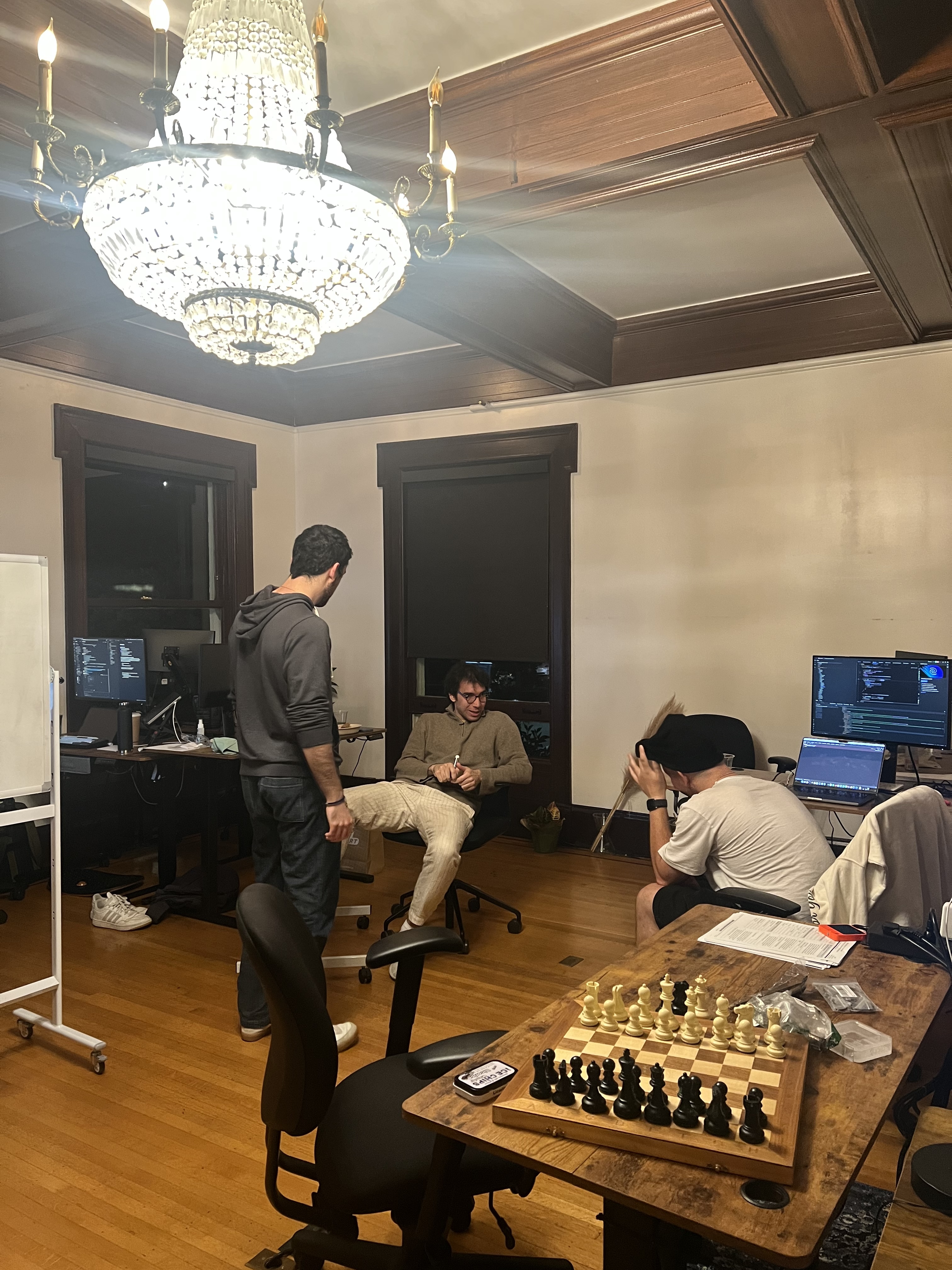
We're not a photogenic team - we're usually just building. Flashnet is a larger team now, with some of the best talent in crypto working on problems that didn't exist two years ago. This photo is from earlier days. We should probably update it with the full team, but for now, this is where it started.